Showing posts with label Kel Kelly. Show all posts

Tuesday, September 6, 2011

“Buy American Only?” A Letter From a Concerned Citizen

By Zach Foster
This article is also featured on the Political Spectrum

Dear [friend], thank you so much for writing to me with your concerns.  I happen to share your deep concern for the fate of working class America, especially since the recession (which I justifiably call the Second Great Depression) has fallen the hardest on the backs of the working poor and the middle classes.

I'm also concerned with the fact that so many of our products come from China and other overseas producers.  Unfortunately, this is not necessarily the fault of American producers but rather that of government intervention in the economy.

What I'm about to say to you might seem a little crazy, but I urge you to bear with me.

The Myth of Protecting American Industry
Buying American products alone will do nothing to restore our economy, nor will it bring production and jobs back to the country.  Instead, what this does is actually raise prices and diminish the quality of domestic products, since producers now know that they have American buyers captive and no longer need to make the best products; they know that the law is on their side.

When I say that I'm all for free market capitalism, it means that the market needs to be truly free and unrestrained in order for consumer sovereignty to take place.  By consumer sovereignty, I refer to the old notion that "the consumer is king" or "the customer is always right", and according to this ideology, producers who want to get rich know that the only HONEST way to do this is to produce the BEST QUALITY goods at the LOWEST COST and sell them at the lowest possible price.  This is how hard-working Americans have been getting rich for centuries.

Unfortunately, there are those who have found easy ways to get rich through the evils of government intervention.  I’ll explain this momentarily.

There have been periods in American history where there were high tariffs on imported goods (and some of these taxes still exist) which were meant to improve conditions for American businesses and consumers, but instead made things worse.  The free market is all about competition, and tariffs are essentially meant to kill competition.  Not only do tariffs on imports cause many American producers to lose their incentive to produce high quality goods at low prices (because without the competition they know they have their consumers by the throat), but often times foreign countries retaliate.  Because our high taxes make it harder for them to sell their countries’ products in America, they in turn set super high tariffs to punish American producers.  Therefore, the quality of goods produced at home goes down, the prices of those low-quality goods goes up, and the quality of foreign goods which are often good quality is now super high.

Interventionism
This happened during the Great Depression, and both the Hoover and Roosevelt administrations have blood on their hands.  Both administrations, among many other anti-free market crimes, dramatically raised tariffs on foreign goods under the myth that it would boost American industry.  They also set minimum wage laws that were meant to protect incomes.  Well, guess what the tariffs DIDN’T do for our economy and job creation, and guess how foreign countries reacted to them.  Regarding the minimum wage laws, they made production more expensive and unmaintainable for producers, so instead of only having some pay cuts, they ended up having to lay off workers or just went under completely, thus laying off all workers.  Furthermore, small and medium-sized employers were no longer able to afford to hire people because they couldn’t pay X dollars per hour.  Removing the regulations and interventionist measures that strangle industry will ultimately make it less expensive to create jobs in America, and jobs will migrate back from the third world.

Because of the government stepping in to be the hero, business growth is stunted, and that stunted growth also stunted job creation, and things are more expensive for everyone.  Many big businesses will send lobbyists to the federal government because most of this is EXACTLY what they want.  They want to be able to charge higher prices for cheaply produced goods, and they want no foreign competition, especially not from foreigners who are probably making things better and selling them cheaper.  The one thing these greedy businesses DON’T see is that, while they’ll make a profit from their captive consumers in the short run, everyone gets poor in the long run and these businesses fail and end up having to be bailed out by the federal government. This is not what the free market ever intended.

For more on the evils of regulation, you can check out Frederic Bastiat’s book The Law, which talks about how government intervention and regulation empowers the two main forms of plunder: stupid greed and false philanthropy.  The producers getting lazy on the quality of their products because people can only afford to buy American falls under stupid greed.  The regulations and minimum wage laws and “job creation” bills, “consumer protection” bills, etc., fall under false philanthropy.  You can also see chapter 18 of Jeffery Tucker’s book Bourbon For Breakfast (chapter titled “How Free is the Free Market?”).  I also HIGHLY recommend chapters 1 and 2 of Kel Kelly’s book The Case For Legalizing Capitalism, which fully explain the consequences of government intervention on stateside producers as well as international trade (and this book is a lot of fun to read and easy to understand).  All three books can be downloaded in full and for free at Mises.org/books.

Continued in part 2: Bailouts, the Federal Reserve, and the Contender

Thursday, August 25, 2011

How Government Regulations Create Lower Wages and Unemployment

By Kel Kelly

The consequences of any regulation that government imposes in the workplace are ultimately borne by workers and/or consumers. The more costs imposed on employers—for example, requiring better workplace health and safety regulations—the lower salary workers receive. As we’ve seen above, the costs cannot come out of profits, or else the companies will go under.

It is a mistake to think that workers need “protective” regulation at all; it is a fallacy to believe that workplaces will not improve without forced regulation. OSHA and EPA regulations came about only in the 1960s and 1970s as workplaces had already reached a state similar to what they are today. In other words, workplaces have been improving for hundreds of years without government force. Employers have a natural incentive to make workplaces safer, healthier, and more comfortable in order to attract laborers. For example, if company A has air conditioning and a safer environment than workplace B, which is uncomfortably hot and less safe, workers will choose workplace A as long as they are paid the same. Companies with less desirable workplaces will have to pay more for labor, but since they can’t easily afford to pay higher salaries, they compete with more satisfactory workplaces.  This is why many workplaces today offer gyms, free food and drinks, entertainment, and other amenities voluntarily, without government force. In India, the outsourcing boom has resulted in a lack of qualified workers, and companies are not only bidding up wages to the point that they are increasing at over 30 percent per year, but they are also competing by offering myriad other benefits such as defined career paths, quicker promotions, more workplace amenities and services (such as transportation to work), more holidays, and flexible work schedules.

But when government tries to force such improvements before they are economically viable, workers will foot the bill with lower salaries. Think of the American textile factories in the early part of last century. They were hot in the summer and cold in the winter.  They had poor lighting and bathrooms (if they had any bathrooms at all). Now suppose the government had forced employers to install central air, which since it was invented only in 1902, was still enormously costly even in, say, 1910. Suppose further that the employers were forced to install nicer, bigger bathrooms with a minimum number of stalls. In addition, imagine they were compelled to put in carpet, more windows, cutting edge technology lighting, and a break room stocked with food. Clearly, the less developed workplaces of those days could not have afforded such luxuries. They would have had to lay off many workers to pay for the additions, or else paid workers much less money. To have paid for improvements out of profits would have resulted in business losses, and thus the entire business would have gone under.


© 2010 by the Ludwig von Mises Institute and published under the Creative Commons Attribution License 3.0. http://creativecommons.org/licenses/by/3.0/

Tuesday, July 12, 2011

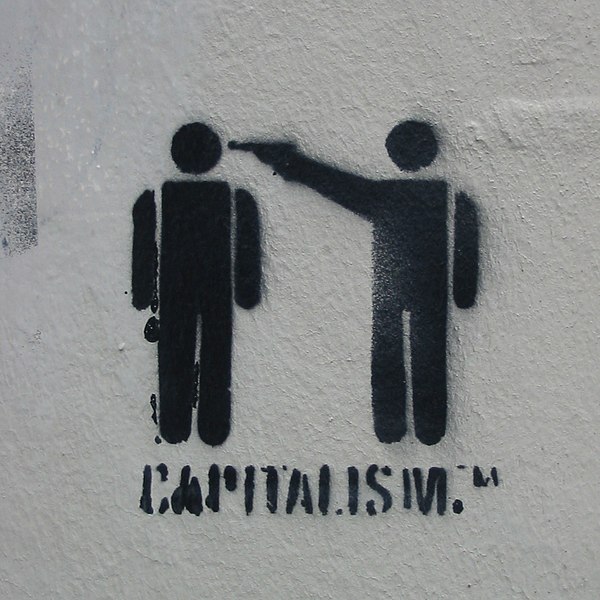
Capitalists Are Not Greedy, You Are


You've been lied to--led to
believe that capitalism only destroys
and that socialism can provide
better than the free market.
Photo from Wikimedia commons

The term greed is used by socialists to deride people or companies for both 1) becoming wealthy in free markets wherein wealth could not have been gained without having created much more wealth for the rest of society, and 2) causing the economic problems that are in reality caused by the government leaders the socialists voted for. The word greed is used in the former case merely to express jealousy for actions which involve nothing negative or shameful, and in the latter case to assign blame to those who socialists wish were guilty, even though they have no idea who is really at fault.

Both greed and wealth are relative terms. The word greed, defined by Merriam-Webster dictionary as “a selfish and excessive desire for more of something (like money) than is needed,” shouldn’t even be part of our vocabulary for the most part. Who is to say how much is “needed”? People usually argue that a rich businessman does not “need” billions of dollars, or does not “need” millions of times more wealth than the average person has. But why not? After all, the average person today has millions of times more wealth than the poor in many countries. Those poor would look at us and say that we don’t “need” mp3 players, trips to Disney World, three bedroom homes instead of two, or two family cars (or even one). Three hundred years ago no one had such things. Why do we have and need them now?  But had you been a commoner back then, you would have said that the King did not “need” all his wealth; but most today live better than did kings back then, even if we don’t have as many physical possessions.  When future generations live like millionaires do today, they will say that those who have a trillion dollars (instead of tens of billions that the richest have today), do not “need” it, but will defend their own “need” for living like a millionaire does today. It’s all relative.

The fact is that most of us largely rational human beings are never wholly satisfied. Given the opportunity, we would all like to have more food, more clothing, more or bigger homes, more vacations, a nicer or more elegant automobile, or more dinners and drinks out with friends. My mother has said, as so many people do, that she has everything she needs. She does not want a bigger house or a boat or a newer car. Yet she decided not to travel to Europe last year because of the falling dollar, not to redecorate her out-of-date home, not to buy a separate utility vehicle for running errands—all because these things are too expensive. Though she claims she doesn’t need more wealth, it’s clear that she would enjoy her life more if she had certain things that wealth could buy. We should therefore understand why Donald Trump “needs” five houses, Paris Hilton “needs” a $500,000 clubbing budget, and I “need” an apartment in Paris. These things make our lives more enjoyable.

This is not at all to discount the happiness that comes from spiritual, emotional and cultural experiences; but such things are outside the scope of this book, the subject of which is economic. Although money does not always buy happiness, it often does. It may not solve all our problems, but it sure can solve many of them. It can definitely buy us safety and security for the most part. And once we have our basic needs, money can buy us relaxation, pleasure, entertainment, and a focus away from our worries. It can even get us out of prison in a third-world country (via bribes) after partying too hard and being arrested for drunken tirades towards police officers. Whatever other problems we have in our lives, money can make things better. The more money we have, the more we can enjoy ourselves.

What about corporate “greed”? Again there is no such thing: don’t confuse greed with theft or mismanagement. The actions of Bernie Madoff, Jeffrey Skilling, Ken Lay and the like are actions of thieves —like those of a burglar, scam artist, or mugger. These are actions which are against the laws of capitalism.

This essay is an excerpt from Kel Kelly’s book The Case For Legalizing Capitalism, © 2010 by the Ludwig von Mises Institute.  It was published under the Creative Commons Attributions License 3.0. http://creativecommons.org/licenses/by/3.0/