Showing posts with label free market. Show all posts

Friday, November 25, 2011

A Case for Free-Market Bank Regulation

By Anthony W. Hager
 
Bank of America (BAC) has rescinded its plan to charge customers a $5 monthly debit-card fee. Shall we praise bank regulators for their swift action in preventing the exorbitant charge? Well, no. Then we'll credit politicians for legislating against greedy, big-bank profiteering, right? Wrong again. The free market drove BAC to drop the debit-card fee.
 
Several banks have floated similar debit-card fees — some already assess the monthly charge — and each met the same fate as BAC. Customers informed their financial institutions that they would rather pull their assets than pay the fee. Banks responded in predictable fashion. Banks need customers in order to remain solvent; therefore they heed their customers' complaints and outrage, whether or not they are reasonable. That's the free market in action. Unpopular fees and programs are abandoned just as surely as profits are taken. Everything depends on what the market will bear.
 
The $5 debit-card charge was never a product of free-market capitalism. It was the result of political machinations, most notably on the part of Senator Dick Durbin. Durbin's amendment to the Dodd-Frank bank reform legislation placed an arbitrary cap on debit-card interchange fees, which banks impose on retailers for each swipe of a customer's card.
 
Banks collect this fee to maintain their electronic networks, retailers distribute the fee among their customers, and customers enjoy the convenience of cashless transactions… (Read more)
 
Source: Mises.org

Tuesday, July 12, 2011

Capitalists Are Not Greedy, You Are


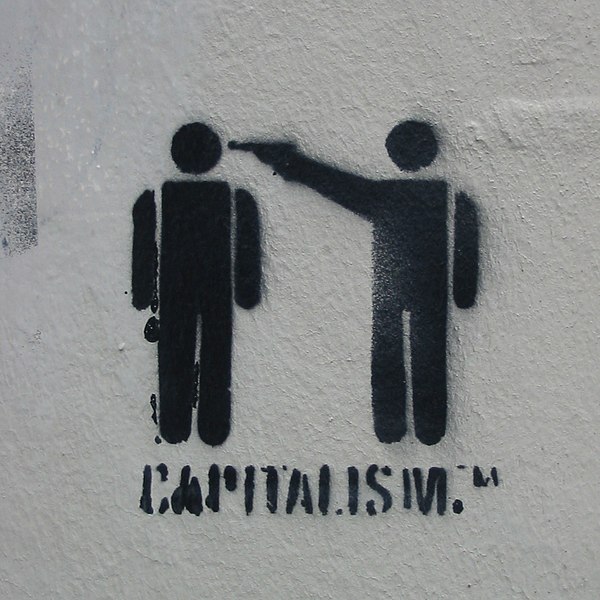
You've been lied to--led to
believe that capitalism only destroys
and that socialism can provide
better than the free market.
Photo from Wikimedia commons

The term greed is used by socialists to deride people or companies for both 1) becoming wealthy in free markets wherein wealth could not have been gained without having created much more wealth for the rest of society, and 2) causing the economic problems that are in reality caused by the government leaders the socialists voted for. The word greed is used in the former case merely to express jealousy for actions which involve nothing negative or shameful, and in the latter case to assign blame to those who socialists wish were guilty, even though they have no idea who is really at fault.

Both greed and wealth are relative terms. The word greed, defined by Merriam-Webster dictionary as “a selfish and excessive desire for more of something (like money) than is needed,” shouldn’t even be part of our vocabulary for the most part. Who is to say how much is “needed”? People usually argue that a rich businessman does not “need” billions of dollars, or does not “need” millions of times more wealth than the average person has. But why not? After all, the average person today has millions of times more wealth than the poor in many countries. Those poor would look at us and say that we don’t “need” mp3 players, trips to Disney World, three bedroom homes instead of two, or two family cars (or even one). Three hundred years ago no one had such things. Why do we have and need them now?  But had you been a commoner back then, you would have said that the King did not “need” all his wealth; but most today live better than did kings back then, even if we don’t have as many physical possessions.  When future generations live like millionaires do today, they will say that those who have a trillion dollars (instead of tens of billions that the richest have today), do not “need” it, but will defend their own “need” for living like a millionaire does today. It’s all relative.

The fact is that most of us largely rational human beings are never wholly satisfied. Given the opportunity, we would all like to have more food, more clothing, more or bigger homes, more vacations, a nicer or more elegant automobile, or more dinners and drinks out with friends. My mother has said, as so many people do, that she has everything she needs. She does not want a bigger house or a boat or a newer car. Yet she decided not to travel to Europe last year because of the falling dollar, not to redecorate her out-of-date home, not to buy a separate utility vehicle for running errands—all because these things are too expensive. Though she claims she doesn’t need more wealth, it’s clear that she would enjoy her life more if she had certain things that wealth could buy. We should therefore understand why Donald Trump “needs” five houses, Paris Hilton “needs” a $500,000 clubbing budget, and I “need” an apartment in Paris. These things make our lives more enjoyable.

This is not at all to discount the happiness that comes from spiritual, emotional and cultural experiences; but such things are outside the scope of this book, the subject of which is economic. Although money does not always buy happiness, it often does. It may not solve all our problems, but it sure can solve many of them. It can definitely buy us safety and security for the most part. And once we have our basic needs, money can buy us relaxation, pleasure, entertainment, and a focus away from our worries. It can even get us out of prison in a third-world country (via bribes) after partying too hard and being arrested for drunken tirades towards police officers. Whatever other problems we have in our lives, money can make things better. The more money we have, the more we can enjoy ourselves.

What about corporate “greed”? Again there is no such thing: don’t confuse greed with theft or mismanagement. The actions of Bernie Madoff, Jeffrey Skilling, Ken Lay and the like are actions of thieves —like those of a burglar, scam artist, or mugger. These are actions which are against the laws of capitalism.

This essay is an excerpt from Kel Kelly’s book The Case For Legalizing Capitalism, © 2010 by the Ludwig von Mises Institute.  It was published under the Creative Commons Attributions License 3.0. http://creativecommons.org/licenses/by/3.0/

Friday, June 24, 2011

A Refreshing Model of Free Markets

An anecdote by Zach Foster
This piece originally appeared in The Political Spectrum in January

Today as I was driving home from the gym I saw a couple of kids had set up a lemonade stand on the corner near their home.  I’d just finished working out and was pretty thirsty, plus it’s always great to see kids earning their own cash, so I stopped and bought a glass of lemonade (which was delicious, they did a good job).  I evaluated the situation and was highly pleased with what I saw.

These two kids got their parents’ permission to pick some lemons from the tree in their yard and used them to make the sweet drink I was currently enjoying.  They also invested in buying plastic cups from the discount store.  Then they set up a stand which was attracting the business of thirsty passers-by.  These kids, plain and simple, made a financial investment and created a job for themselves, in which they were turning a good profit.

Better yet, they also hired their little brother, who was a few years younger than them, to hold up their sign for drivers to see as they passed.  They not only created their own jobs, but also a job for their little brother.  He wasn’t making anywhere near as much money as his older siblings, but he was very young, probably too young to have the skills to set up his own stand.  He was very happy that he was making money.  What he didn’t realize was that on top of the money he was earning by working for his enterprising siblings, he was learning valuable skills so that he might one day set up his own lemonade stand.

After their business day was done, these kids most likely would have spent the money they made at the local toy store or candy store, thus stimulating the economy.  What these kids were doing was practicing a perfect model of the free market system.  I was genuinely impressed!  Then I chuckled, realizing that I had just supported not only these young entrepreneurs, but also the free market system in my community.  Then I laughed, knowing this would have infuriated my Marxist friends.

Wednesday, June 22, 2011

Free Market Consequences of the Nanny State, part 2


By Zach Foster
Continued from Part 1

Legalization of narcotics would bring a true victory—or at least a Nixonian Peace With Honor—in the War on Drugs.  How so?  First and foremost, safety would rise dramatically in areas affected by drug-related violence.  With narcotics available at drug stores or dispensaries, they would no longer be a part of the underground market, robbing the drug lords of both their consumer base and their profits, and by extension destroying any need to fight law enforcement and other cartels.  Shootings and assassinations would decline sharply just the way alcohol-related gang violence plummeted after Prohibition was repealed.  This means that both cartel violence and local gang commerce and violence—all of them fueled by drug money—would decline sharply.  If not, they could at least branch out to become legitimate enterprises under government regulation, so people would at least not be getting killed in gun battles.[1]  If Wal-Mart and Target can exist in the same city without having routine gun battles, kidnappings, and executions, then two former cartels can compete peacefully in the free market under the law.

Better yet, drug use would actually be safer if state governments regulated production according to health laws.  This means that under state supervision, narcotics could be purely organic and NOT be mixed with cement, quicklime, sulfuric acid, and other deadly chemicals.  Yes, there would still be the possibility of drug overdoses occurring, but that is a matter of personal discretion.  Over 20,000 people die every year from alcohol causes (EXCLUDING drunk driving incidents), mainly alcohol poisoning.[2]  What has the nanny state done to protect these people?  Nothing, as it is impossible to protect determined people from harming themselves.  At least with state regulated non-toxic drugs, users wouldn’t be dropping like flies.

An economic incentive for the nanny state to get out of local drug matters (as if the safety and health aspects weren’t enough) is the potential tax revenue.[3]  This means that both the state and the federal government can tax this vice.  Right now marijuana prices vary, but are quite high in comparison to tobacco and alcohol.  Several decent quality joints would cost the same as at least a full carton (10 packs) of cigarettes, or two bottles of good quality Jack Daniels.  In the west coast, an ounce of decent marijuana costs anywhere between two and three hundred dollars.  On the west coast, an ounce costs well over four hundred.

The high pricing has nothing to do with the time or labor being put into growing and harvesting marijuana. If that was the case, then corn, apples, cotton, and tobacco would also cost three hundred dollars an ounce.  The reason narcotics—especially marijuana—are so expensive is supply and demand.  A huge amount of narcotics are harvested and manufactured every single day, both in the U.S. and south of the border.  In some cases, farmers have huge amounts of illegal crops.  In most cases, a lot of people have a few plants.  Because of federal laws, only so much can be harvested and sold before the Feds take notice, either to legal dispensaries or on the underground market.  It is known that every single day the U.S. Border Patrol and Immigrations and Customs Enforcement agencies catch tens of millions of dollars’ worth of narcotics being smuggled into the country.  The fact that so many narcotics are produced attests to the fact that there is a huge demand for them.  The fact that the supply is severely limited, both by law enforcement operations and producer cautiousness, explains why the price is so high.  Even with heavy taxation, narcotics on the free market will no longer cost hundreds of dollars, and prices will ultimately be lower.

Continued in Part 3: Helping People Kick the Habit


[1] Stamper, Norm. How Legalizing Drugs Will End the Violence. http://www.alternet.org/drugs/39565/
[2] Drinking: The Danger Zone. http://www.parent-teen.com/substances/poisoning2.html
[3] Miron, Jeffrey. The Budgetary Implications of Drug Prohibition. Harvard University. February 2010.http://www.economics.harvard.edu/faculty/miron/files/budget%202010%20Final.pdf