Monday, July 18, 2011

United States Mint Announces Launch Ceremony Dates for Quarters Honoring Vicksburg National Military Park and Chickasaw National Recreation Area

WASHINGTON - August typically signals the end of summer, but there are still enough pleasant days left to enjoy the serenity of our Nation's pristine national parks and sites.  Vicksburg National Military Park in Mississippi will be the site of the launch ceremony for the new America the Beautiful Quarters® Program coin struck in the park's honor.  The ceremony will take place Tuesday, August 30 at the USS Cairo Museum located on the grounds of the park.  The ceremony starts at 9:30 a.m. Central Time (CT). 

In November, Oklahomans and the rest of the Nation will have two things to celebrate:  the 104th anniversary of the Oklahoma's admission into the Union and the release of the new quarter honoring Chickasaw National Recreation Area.  The launch ceremony will take place Wednesday, November 16 at The Point at the Lake of the Arbuckles boat launch parking lot in Sulphur, Okla.  The ceremony starts at 11 a.m. CT.

Both events include a coin exchange after the ceremony where participants can exchange their cash for rolls containing the honored site's new quarter.  Children 18 years old and younger will receive a free quarter to commemorate the event.

Additionally, the United States Mint will hold a coin forum the evening before each quarter launch ceremony where the public can discuss future U.S. coinage and learn about United States Mint initiatives and coin programs.  Information about the coin forums will be available in the coming weeks.

The United States Mint, created by Congress in 1792, is the Nation's sole manufacturer of legal tender coinage and is responsible for producing circulating coinage for the Nation to conduct its trade and commerce.  The United States Mint also produces proof, uncirculated and commemorative coins; Congressional Gold Medals; and silver, gold and platinum bullion coins.

A Big Week for the New Consumer Agency

By Elizabeth Warren

This is a big week for the Consumer Financial Protection Bureau (CFPB). Today, the President will announce his intent to nominate Richard Cordray to serve as the first Director of the Consumer Financial Protection Bureau. On Thursday, the CFPB makes its transition from a start-up to a real, live agency with the authority to write rules and to supervise the activities of America's largest banks.

Rich will be a strong leader for this agency. He has a proven track record of fighting for families during his time as head of the CFPB enforcement division, as Attorney General of Ohio, and throughout his career. He was one of the first senior executives I recruited for the agency, and his hard work and deep commitment make it clear he can make many important contributions in leading it. Rich is smart, he is tough, and he will make a stellar Director. I am very pleased for him and very pleased for the CFPB.

The DNA of the new consumer agency is well established. Our mission is clear: No one should be tricked in any financial transaction. Prices and risks should be clear. People should be able to make apples-to-apples comparisons. Fine print should be mowed down, not used to hide nasty surprises. And, everyone -- even trillion dollar banks -- should follow the law.

We're underway. We are working through a much-simplified mortgage disclosure form. We are designing a new consumer complaint process, with the first piece coming on line this week. We have set up a strong Office of Servicemember Affairs that reaches out to military families and is already working on problems they face. And, on Thursday, we will have cops on the beat -- making our first contacts with the 111 largest financial institutions in the country so we can monitor their compliance with the law. We have hired the people and built the systems to make all this work. And, to cap it all off, we got a strong evaluation from the Inspector General last Friday about our efficient and drama-free set up period.

There's lots of good news, but make no mistake: this agency still has enemies in Washington, D.C. And they have a plan.

In May, forty-four Republican Senators wrote a letter saying that they will block anyone from serving as CFPB Director. Many of them don't like the agency or the ideas that led to its creation. They lost that fight last summer in a straight-up vote, but they say they will use a filibuster over a Director nomination to undercut the agency. Without a Director, however, the agency's authority over payday lenders, debt collectors and other non-bank financial companies can be challenged. The Republicans say that they will permit a Director only if the agency is amended to make it less independent and less likely to act.

I remain hopeful that those who want to cripple this consumer bureau will think again and remember that the financial crisis -- and the recession and job losses that it sparked -- began one lousy mortgage at a time. I also hope that when those Senators next go home, they ask their constituents how they feel about fine print, about signing contracts with terms that are incomprehensible, and about learning the true costs of a financial transaction only later when fees are piled on or interest rates are reset. I hope they will ask the people in their districts if they are opposed to an agency that is working to make prices clear or if they think budgets should be cut for an agency that is trying to make sure that trillion-dollar banks follow the law. I hope they will ask their constituents if they are opposed to the confirmation of someone who saved $2 billion for retirees, investors, and business owners as Ohio Attorney General and who has worked hard on the front lines fighting against fraudulent foreclosures and abusive lending practices.

This week is the culmination of two years of hard battles. The President put the consumer agency in his first outline of financial regulatory reform, and he never wavered in his support for it. The agency was declared dead several times, and weak versions and lousy bargains were offered again and again, but he stood fast. When he signed Dodd-Frank into law, creating the new agency, he offered me the chance to stand it up -- something for which I will always be grateful. The fights continued, and again, the President never wavered in his support. In fact, just last week he issued a veto threat if the Republicans try to move the agency's funding to the political process, and I know that in the future he won't allow opponents of reform to succeed in weakening the CFPB.

The agency has stepped out in the right direction. The work is good. But this agency needs to have its full powers right now, and that means we need Rich in place as Director. Today, I'm celebrating -- but I'm not taking my eye off those who want to cripple this agency. We got this agency by fighting, we stood it up by fighting, and, if takes more fighting to keep it strong and independent, then we can do it.

Elizabeth Warren is an Assistant to the President and a Special Advisor to the Secretary of the Treasury on the Consumer Financial Protection Bureau.

Standing Up on Behalf of Consumers

A year ago, in the wake of the financial crisis that pulled the economy into the worst recession we've seen since the Great Depression, President Obama passed financial reform to help tackle the problems that led us into the recession in the first place. 

As the President described today, the law did three things: "First, it made taxpayer-funded bailouts illegal, so taxpayers don’t have to foot the bill if a big bank goes under.  Second, it said to Wall Street firms, you can’t take the same kind of reckless risks that led to the crisis.  And third, it put in place the strongest consumer protections in history."

As part of financial reform, President Obama put one consumer watchdog, the Consumer Financial Protection Bureau, in charge with the sole task of "looking out for regular people in the financial system." 

The President got the idea from Elizabeth Warren, who has spent the past year setting up the bureau and starting the process of setting up protections for consumers – like making sure loan contracts and credit card terms are simpler and written in plain English and ensuring men and women in uniform are protected against fraud and deception in financial practices.

Today, President Obama nominated Richard Cordray as Director of the Consumer Financial Protection Bureau. In his remarks, the President spoke about the tens of millions of dollars lobbyists and lawyers have spent this year trying to undo progress by weakening the laws that protect consumers:

“The fact is the financial crisis and the recession were not the result of normal economic cycles or just a run of bad luck. They were abuses and there was a lack of smart regulations. So we’re not just going to shrug our shoulders and hope it doesn’t happen again. We’re not going to go back to the status quo where consumers couldn’t count on getting protections that they deserved. We’re not going to go back to a time when our whole economy was vulnerable to a massive financial crisis. That’s why reform matters. That’s why this bureau matters. I will fight any efforts to repeal or undermine the important changes that we passed. And we are going to stand up this bureau and make sure it is doing the right thing for middle-class families all across the country.

Middle-class families and seniors don’t have teams of lawyers from blue-chip law firms. They can’t afford to hire a lobbyist to look out for their interests. But they deserve to be treated honestly. They deserve a basic measure of protection against abuse. They shouldn’t have to be a corporate lawyer in order to be able to read something they’re signing to take out a mortgage or to get a credit card. They ought to be free to make informed decisions, to buy a home or open a credit card or take out a student loan, and they should have confidence that they’re not being swindled. And that’s what this consumer bureau will achieve.”

Also, in case you missed it, today Elizabeth Warren published an op-ed endorsing Richard Cordray’s nomination and discussing the Consumer Financial Protection Bureau’s transition this week to a real, live agency with the authority to write rules and supervise the activities of America’s largest banks.

Statement from Secretary Geithner on the Leadership of the Consumer Financial Protection Bureau

WASHINGTON – Today, the U.S. Department of the Treasury issued the following statement from Secretary Tim Geithner in response to the announcement by the White House that President Obama will announce tomorrow his intent to nominate Richard Cordray as the Director of the Consumer Financial Protection Bureau (CFPB). 

“As Ohio’s Attorney General and while at the Consumer Financial Protection Bureau, Richard Cordray has earned a reputation as one of America's strongest advocates for the interests of consumers. He is an effective leader who is committed to making sure American families and consumers have all the necessary tools to make the best possible choices. We are grateful that he has agreed to take on this important position and know he will build upon the powerful legacy that Professor Elizabeth Warren has established at the CFPB. Professor Warren has done an outstanding job at standing up this agency and has been a tremendous asset to us all during the Bureau’s first year. She has helped initiate critical work to simplify mortgage disclosure, improve credit card transparency and shield military families from predatory lenders and has done the agency a great service in recruiting top talent to take the CFPB and its mission forward.”

Friday, July 15, 2011

Pending Free Trade Agreements Are Good for America’s Farmers and Ranchers

The three pending free trade agreements (FTAs) would greatly expand access for America’s agriculture producers in developing markets. Enacting the FTAs would create 18,000 new jobs in the agriculture sector alone.1 Unfortunately, three years after the agreements were negotiated, President Obama has yet to submit any of them to Congress. America’s farmers and ranchers continue to lose market share as the President and Senate Democrats further delay the agreements by insisting they be tied to spending increases.

Korea: Korea is the fifth largest market for U.S. agriculture products and accounted for $5.3 billion in U.S. agriculture exports in 2010. According to the U.S. International Trade Commission, U.S. agriculture exports would increase by approximately $2 billion to $4 billion if this trade agreement were enacted.2 In addition, implementing the U.S.-Korea FTA would create 9,000 new agriculture jobs in the United States.3 Other highlights include:

·         Elimination of Korea’s 40 percent tariff on beef in equal installments over a 15-year period. Beef exports to Korea would likely increase by as much as $1.8 billion.4
·         Elimination of the 25 percent tariff on 90 percent of pork products by 2016, and elimination of the 22.5 percent tariff on other pork products within 10 years.5

If the U.S.-Korea agreement is further delayed, U.S. agriculture producers will continue to lose market share to foreign competitors such as the E.U. The E.U.-Korea trade agreement, which would phase out 94 percent of Korea’s tariffs on E.U. products, took effect on July 1st.6

Colombia: Since the U.S.-Colombia FTA was negotiated in November 2006, U.S. agriculture exports to Colombia have dropped by 50 percent due to delays in implementing this agreement.7 Meanwhile, the Canada-Colombia trade agreement is scheduled to take effect on August 15, 2011, which will further reduce the already diminished U.S. share of the Colombian market.8

While most of Colombia’s agriculture exports to the U.S. already enter duty-free through the Andean Trade Preferences Act, most U.S. agriculture exports to Colombia face stiff tariffs. If the FTA were enacted, many of these tariffs would be immediately eliminated, and U.S. agriculture exports to Colombia could increase by $370 million per year.9 Other highlights include:

·         Immediate elimination of tariffs on 77 percent of agriculture exports to Colombia; and most other tariffs on agriculture exports will be reduced over a 15-year period.10
·         Immediate elimination of the 5 to 20 percent tariff on most vegetables, wheat, barley, and soybeans, plus a 12-year phase out of the maximum 25 percent tariff on corn.11
·         Immediate elimination of the 80 percent tariff on prime and choice cuts of beef, and a five-year phase out the 20 to 30 percent tariff on most pork products.12 Beef and pork exports to Colombia would increase by an estimated 46 percent and 72 percent, respectively.13

Panama: Enacting this agreement would result in $195 million in increased annual U.S. agriculture exports to Panama, which already account for over half of Panama’s agriculture import market.14 On average, a 15 percent tariff is currently applied to most U.S. agriculture exports to Panama while most of Panama’s exports to the U.S. enter duty-free.15 Other highlights include:

·         Immediate duty-free access for two-thirds of U.S. agriculture exports including high quality beef, soybeans, poultry products, most fresh fruits, and most processed foods.16
·         In general, most of the remaining tariffs would be phased out over 17 years.17
·         Immediate duty-free access for a set amount of corn, and elimination of the out-of-quota 40 percent tariff over 15 years.18
·         Elimination of the 90 percent rice tariff over 20 years.19
·         President Obama continues to delay these common-sense trade agreements for his own political gain, and America’s agriculture producers are paying the price.

_________________________

1 “Ag groups: Three pending free trade agreements need action,” Jennifer Latzke, High Plains Journal, http://goo.gl/sXb74.

2 “The Proposed U.S.-South Korea Free Trade Agreement (KORUS FTA): Provisions and Implications,” Congressional Research Service, May 2, 2011, http://goo.gl/7LNzf.

3 Supra Note 1, http://goo.gl/sXb74.

4 Supra Note 2, http://goo.gl/7LNzf.

5 Ibid

6 “Pending Free Trade Agreements,” American Farm Bureau Federation, June 2011, http://goo.gl/xhN0H.

7 “AFBF Advocates Passing FTAs at World Trade Month Event,” American Farm Bureau Federation, May 24, 2011, http://www.fb.org/index.php?action=newsroom.news&year=2011&file=nr0524.html.

8 “As trade pact with US sits, Colombia looks to China, others,” Howard LaPranchi, Christian Science Monitor, June 18, 2011, http://goo.gl/TzVyf.

9 Supra Note 6, http://goo.gl/xhN0H.

10 “Fact Sheet: U.S.-Colombia Trade Promotion Agreement Overall Agriculture Fact Sheet,” United States Department of Agriculture (USDA), Foreign Agricultural Service, September 2009, http://goo.gl/RxiyK.

11 Ibid

12 “Trade Agreement Would Promote U.S. Exports and Colombian Civil Society,” Juan Carlos Hidalgo, Cato Institute, February 15, 2011, http://www.cato.org/pub_display.php?pub_id=12783.

13 Ibid

14 “Agriculture in Pending U.S. Free Trade Agreements with Colombia, Panama, and South Korea,” Congressional Research Service, February 14, 2011, http://goo.gl/qEP02.

15 “The Proposed U.S.-Panama Free Trade Agreement,” Congressional Research Service, May 23, 2011, http://goo.gl/i9E3s

16 Supra Note 14, http://goo.gl/qEP02.

17 Ibid

18 “U.S.-Panama Trade Promotion Agreement,” the White House, http://goo.gl/paE9Q.

19 Ibid

Tuesday, July 12, 2011

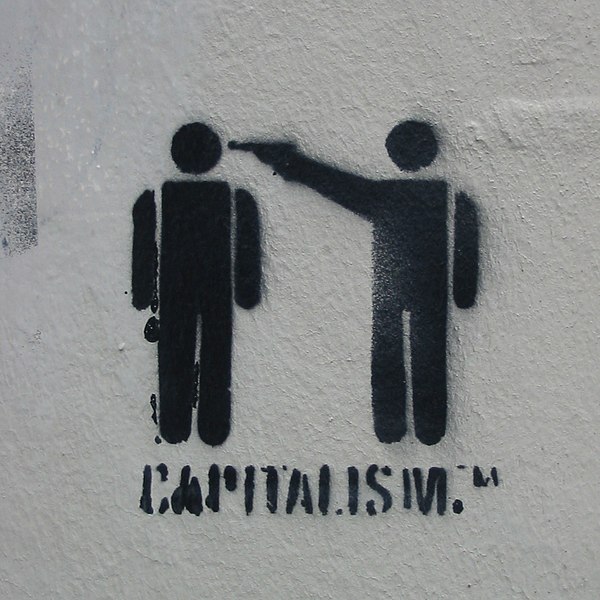
Capitalists Are Not Greedy, You Are


You've been lied to--led to
believe that capitalism only destroys
and that socialism can provide
better than the free market.
Photo from Wikimedia commons

The term greed is used by socialists to deride people or companies for both 1) becoming wealthy in free markets wherein wealth could not have been gained without having created much more wealth for the rest of society, and 2) causing the economic problems that are in reality caused by the government leaders the socialists voted for. The word greed is used in the former case merely to express jealousy for actions which involve nothing negative or shameful, and in the latter case to assign blame to those who socialists wish were guilty, even though they have no idea who is really at fault.

Both greed and wealth are relative terms. The word greed, defined by Merriam-Webster dictionary as “a selfish and excessive desire for more of something (like money) than is needed,” shouldn’t even be part of our vocabulary for the most part. Who is to say how much is “needed”? People usually argue that a rich businessman does not “need” billions of dollars, or does not “need” millions of times more wealth than the average person has. But why not? After all, the average person today has millions of times more wealth than the poor in many countries. Those poor would look at us and say that we don’t “need” mp3 players, trips to Disney World, three bedroom homes instead of two, or two family cars (or even one). Three hundred years ago no one had such things. Why do we have and need them now?  But had you been a commoner back then, you would have said that the King did not “need” all his wealth; but most today live better than did kings back then, even if we don’t have as many physical possessions.  When future generations live like millionaires do today, they will say that those who have a trillion dollars (instead of tens of billions that the richest have today), do not “need” it, but will defend their own “need” for living like a millionaire does today. It’s all relative.

The fact is that most of us largely rational human beings are never wholly satisfied. Given the opportunity, we would all like to have more food, more clothing, more or bigger homes, more vacations, a nicer or more elegant automobile, or more dinners and drinks out with friends. My mother has said, as so many people do, that she has everything she needs. She does not want a bigger house or a boat or a newer car. Yet she decided not to travel to Europe last year because of the falling dollar, not to redecorate her out-of-date home, not to buy a separate utility vehicle for running errands—all because these things are too expensive. Though she claims she doesn’t need more wealth, it’s clear that she would enjoy her life more if she had certain things that wealth could buy. We should therefore understand why Donald Trump “needs” five houses, Paris Hilton “needs” a $500,000 clubbing budget, and I “need” an apartment in Paris. These things make our lives more enjoyable.

This is not at all to discount the happiness that comes from spiritual, emotional and cultural experiences; but such things are outside the scope of this book, the subject of which is economic. Although money does not always buy happiness, it often does. It may not solve all our problems, but it sure can solve many of them. It can definitely buy us safety and security for the most part. And once we have our basic needs, money can buy us relaxation, pleasure, entertainment, and a focus away from our worries. It can even get us out of prison in a third-world country (via bribes) after partying too hard and being arrested for drunken tirades towards police officers. Whatever other problems we have in our lives, money can make things better. The more money we have, the more we can enjoy ourselves.

What about corporate “greed”? Again there is no such thing: don’t confuse greed with theft or mismanagement. The actions of Bernie Madoff, Jeffrey Skilling, Ken Lay and the like are actions of thieves —like those of a burglar, scam artist, or mugger. These are actions which are against the laws of capitalism.

This essay is an excerpt from Kel Kelly’s book The Case For Legalizing Capitalism, © 2010 by the Ludwig von Mises Institute.  It was published under the Creative Commons Attributions License 3.0. http://creativecommons.org/licenses/by/3.0/

Monday, July 11, 2011

San Francisco Man Indicted for Running Multi-Million-Dollar Ponzi Scheme

SAN FRANCISCO—Yesterday a federal grand jury in San Francisco indicted Robert G. Tunnell, Jr., of San Francisco, with seven counts of mail fraud, 13 counts of wire fraud, and one count of money laundering, United States Attorney MELINDA HAAG announced. The charges result from Tunnell allegedly operating a Ponzi scheme from at least January 2006 until his arrest on June 23, 2011.

According to the Indictment, Mr. Tunnell, 72, was an attorney until he resigned from the State Bar of California while charges that he stole approximately $300,000 from his law firm were pending against him. Tunnell subsequently held himself out as a highly successful investor, promising substantial returns while representing that he would invest funds in a conservative, safe, and cautious manner. According to the Indictment, however, Tunnell engaged in risky trading activity with his investors’ money, losing approximately $7 million of the approximately $10 million investors—mostly family members and personal friends—entrusted to him from January 2006 through June 2011. Tunnell used most of the remaining money from his investors to repay other investors and to pay off a debt he owed to a bank after he had failed to repay a loan. Despite these substantial losses and other dissipation of funds, Tunnell consistently and falsely reported gains to his investors, and even created false documents grossly overstating his assets and net worth.

A criminal complaint was filed against Tunnell on June 22, 2011, and he was arrested on June 23, 2011. On June 24, 2011, he was released on bail. He remains out of custody on a $10,000,000 bond secured by the home of a family member. Tunnell was arraigned on the Indictment this morning, and he was ordered to appear before United States District Court Judge Charles R. Breyer on Wednesday, August 10, at 2:15 p.m.

The maximum statutory penalty for each count of mail fraud, in violation of Title 18, United States Code, Section 1341, and each count of wire fraud, in violation of Title 18, United States Code, Section 1343, is 20 years in prison, a fine of $250,000, a three-year term of supervised release, and restitution to victims. The maximum statutory penalty for money laundering, in violation of Title 18, United States Code, Section 1957, is 10 years in prison, a $250,000 fine, a three-year term of supervised release, and restitution. Any sentence following conviction, however, would be imposed by the court after consideration of the U.S. Sentencing Guidelines and the federal statute governing the imposition of a sentence, 18 U.S.C. § 3553.

Doug Sprague is the Assistant U.S. Attorney who is prosecuting the case with the assistance of legal assistant Rayneisha Booth. The prosecution is the result of a three-month investigation by the Federal Bureau of Investigation, with assistance from the United States Commodity Futures Trading Commission.

Please note, an indictment contains only allegations against an individual and, as with all defendants, Mr. Tunnell must be presumed innocent unless and until proven guilty.